Commonwealth of Indigenous Nations · COIN
The Lineage — Backstory of the Eastern Gate
Yamassee–Shoshone Lineage · Guardian of the Eastern Gate · Boston Territory, North America
← COIN Healthcare Network — Home
Yamassee–Shoshone Lineage · Guardian of the Eastern Gate · Boston Territory, North America
← COIN Healthcare Network — Home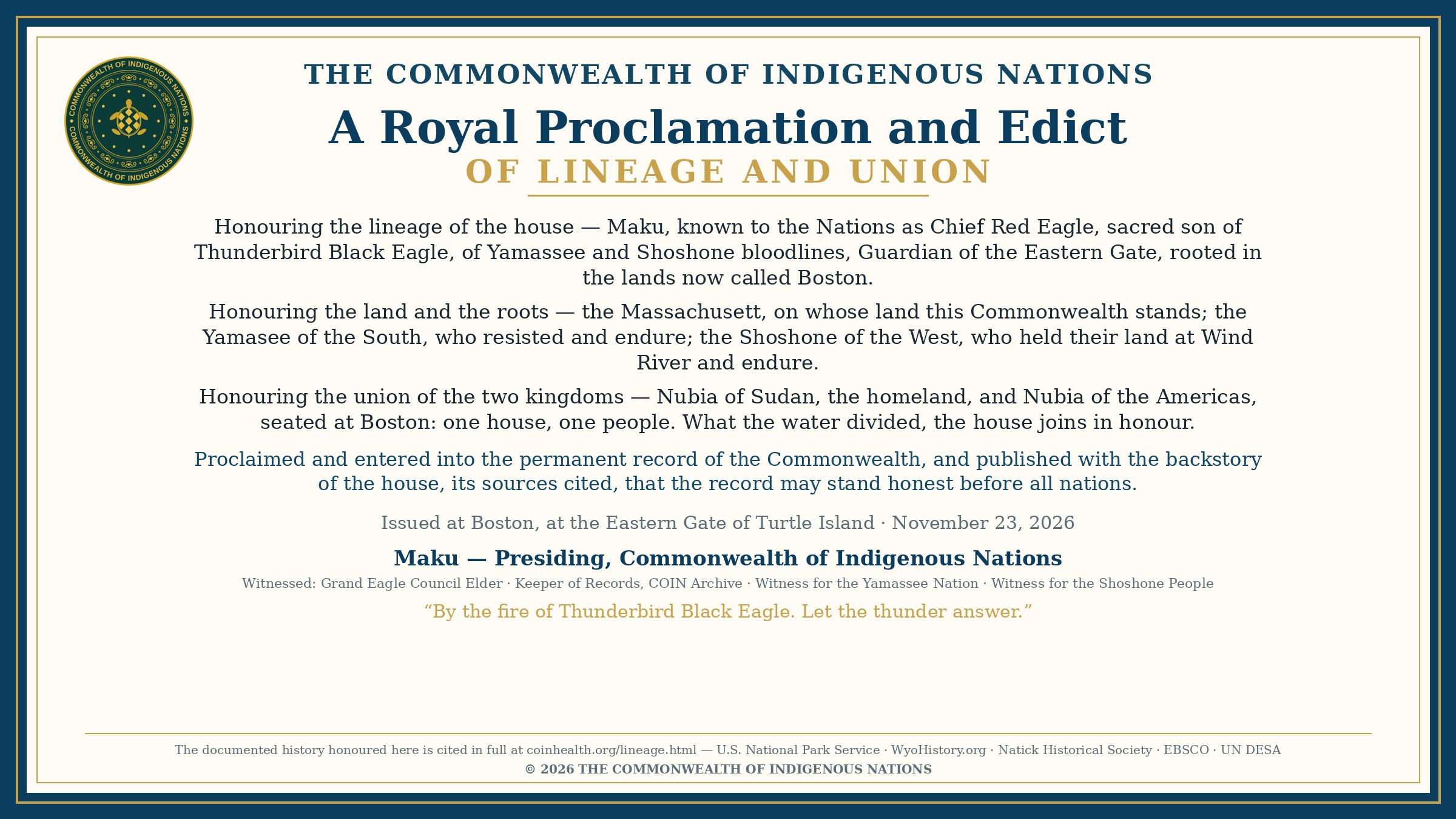
BY THE MAKU OF THE COMMONWEALTH OF INDIGENOUS NATIONS
WHEREAS the house has set down its lineage: Maku, known to the Nations as Chief Red Eagle, sacred son of Thunderbird Black Eagle, of Yamassee and Shoshone bloodlines, Guardian of the Eastern Gate, rooted in the lands now called Boston; and
WHEREAS the record of this land is honoured: the Massachusett, at whose great hill this Commonwealth stands, and whose name the Commonwealth of Massachusetts itself bears; the praying towns of Natick and Ponkapoag; and the souls interned on Deer Island in the winter of 1675–76, who are remembered here; and
WHEREAS the southern root is honoured: the Yamasee, who rose in 1715 against cheating and enslavement and were scattered, yet whose descendants endure; and the western root is honoured: the Shoshone — Newe, the people — who held their land at Wind River under Washakie and endure still; and
WHEREAS there stand two seats of one house — the Kingdom of Nubia in Sudan, the homeland, and the Kingdom in the Americas, seated at Boston — and the house wills that they be honoured together, as one people, merged in one house, neither forgetting the other across the water;
NOW THEREFORE it is PROCLAIMED and DECREED:
Maku — Presiding, Commonwealth of Indigenous Nations
Witnessed: Grand Eagle Council Elder · Keeper of Records, COIN Archive · Witness for the Yamassee Nation · Witness for the Shoshone People
"By the fire of Thunderbird Black Eagle. Let the thunder answer."
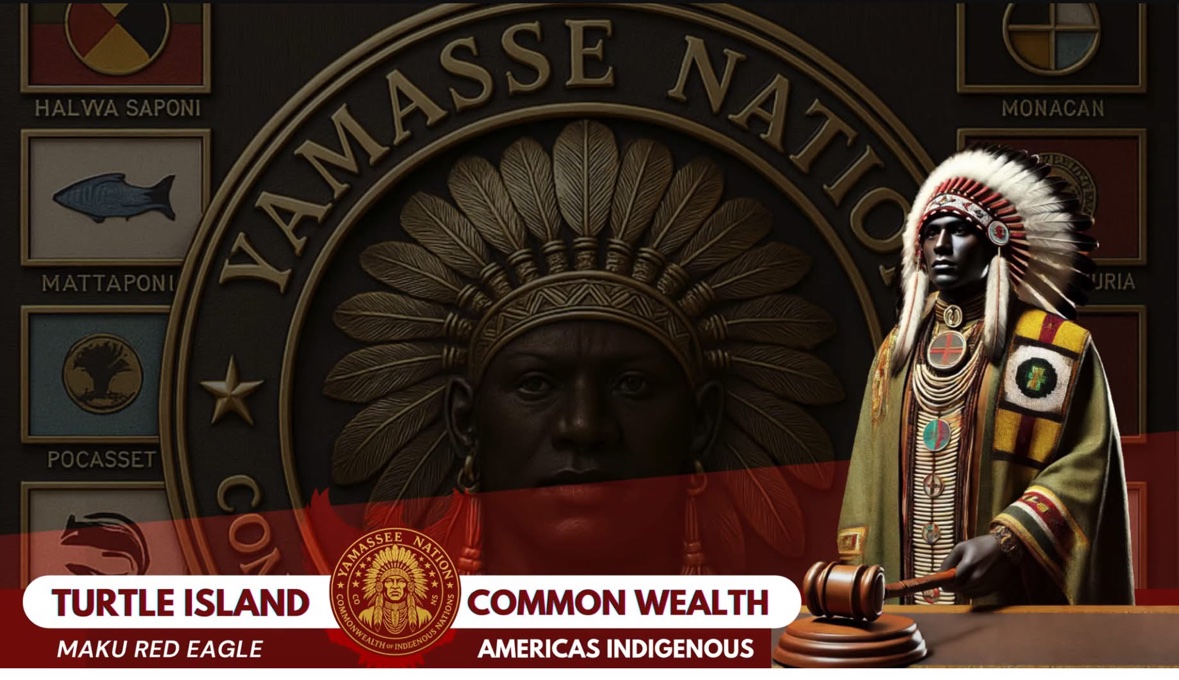
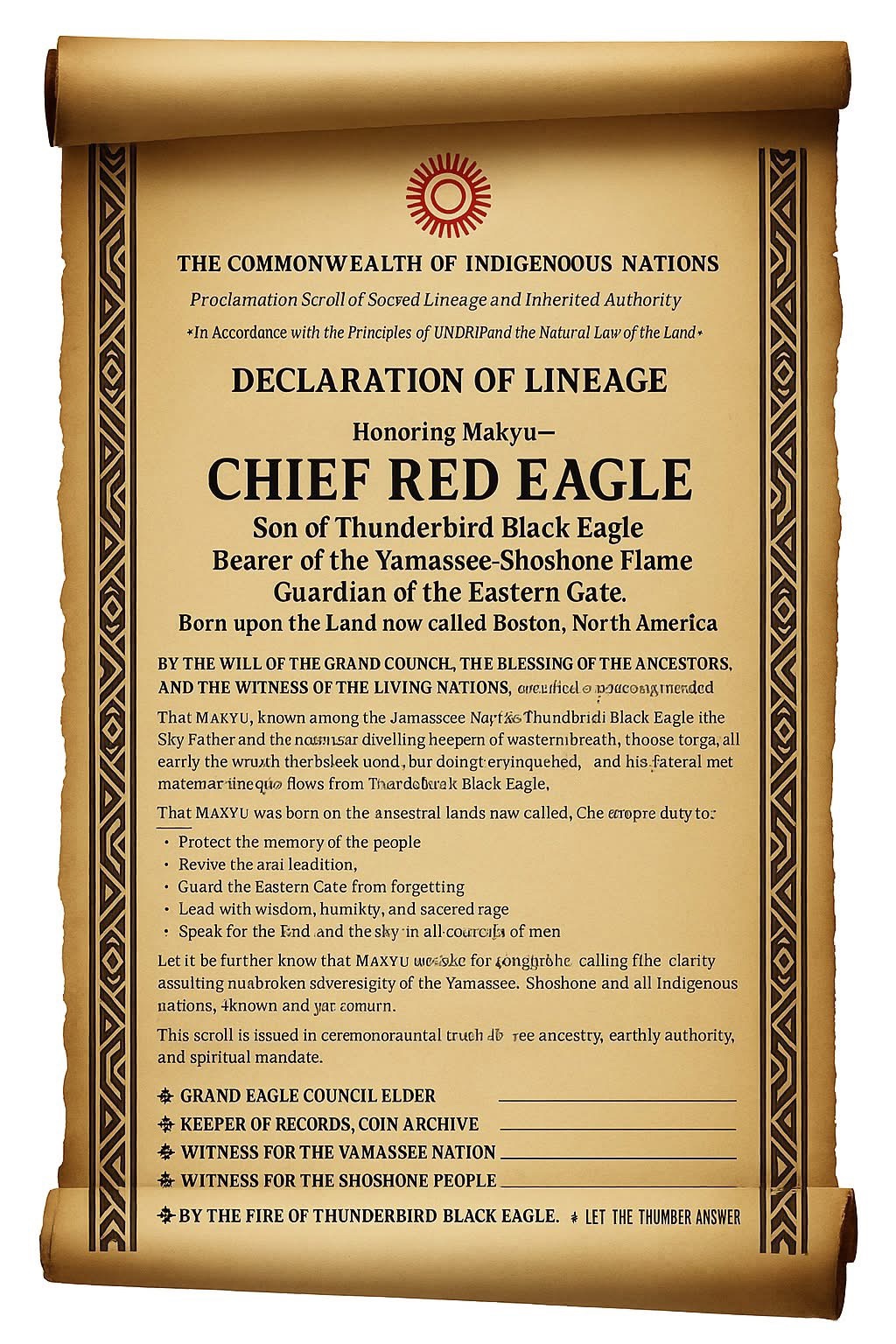
Maku, known to the Nations as Chief Red Eagle, is the sacred son of Thunderbird Black Eagle, a sky-born protector and ancestral spirit who rides the storms and speaks through lightning. Born of Yamassee and Shoshone bloodlines, Makyu carries the wisdom of the South and the strength of the West, rooted deeply in the lands now called Boston, in the northeastern heart of Turtle Island.
Long before colonial settlement, when rivers ran clean and stars told time, his people walked the lands of what is now Massachusetts, keepers of ceremony and stewards of the sacred. From the shoreline of the Atlantic to the valleys of the Shoshone, Maku's blood carries stories older than maps, older than empires.
He was born beneath an eagle's cry, wrapped in the wind of the Eastern Gate. As the son of Thunderbird Black Eagle, his spirit is marked by divine fire. The thunder lives in his voice, and the vision of the eagle sharpens his sight. He rises not only as a warrior, but as a healer, storyteller, and unifier of Nations.
Chief Red Eagle is a name spoken in prayer and ceremony, representing one who bridges realms — sky and soil, past and future, Native and urban. From council fires to city streets, he reminds the people: we are still here.
He leads not with conquest, but with clarity. He calls forth the Yamassee and Shoshone legacies, rooted in resistance, resilience, and reverence. His presence in Boston, a place of early settler encroachment and enduring Indigenous survival, is both reminder and prophecy: the land remembers. The people rise.
Maku walks in the footprints of the ancestors, and his own footprints will one day be the path of generations yet to come.
May his feathers never fall. May his fire never fade.
The Commonwealth of Indigenous Nations stands in Boston, on the homeland of the Massachusett people. The name Massachusett is commonly interpreted as "at the great hill," for the Great Blue Hill that overlooks Boston Harbor — and the colony, then the Commonwealth of Massachusetts, took its very name from the people.[1]
At Moswetuset Hummock, on the shore of Quincy Bay, stood the seat of the sachem Chickatawbut, where the Massachusett held council in the warm season — a place remembered as the origin of the tribe's name, and held on the National Register of Historic Places since 1970.[2]
The people were among the first in New England to meet European explorers, and among the hardest struck: an epidemic around 1619 carried mortality as high as ninety percent in the coastal communities, and further epidemics followed.[1] Under John Eliot's mission, many Massachusett gathered in the praying towns — Natick, founded in 1651, and Ponkapoag, in 1654, among the first — and Eliot's translation of the Bible into the Massachusett language, printed in 1663, became the first Bible printed in America.[3]
When King Philip's War came in 1675, the praying Indians — Christians, allied to neither side — were rounded up and interned on Deer Island in Boston Harbor. Between 500 and 1,100 people were held there through the winter of 1675–76, most of them women and children; with little food and inadequate shelter, about half of them died. Survivors were released in May 1676, and some were sold into slavery in the West Indies.[4] Descendants return to Deer Island every year to commemorate them.[4]
The people did not vanish. The Massachusett Tribe at Ponkapoag carries the name and the memory today, preserving and teaching the history of the first people of this shore.[1] This house records that it stands on their land, and says so plainly.
The house's account names a southern root: the Yamasee — spelled "Yamassee" in the house's own writing, and "Yamasee" in most of the public record. The Yamasee were a multiethnic confederation of Native peoples of the Southeast coast, in what is now Georgia, South Carolina, and northern Florida, considered by scholars a Muskogean-language people.[5]
By the 1680s Yamasee towns stood along the Savannah River, and the Yamasee were trading partners and military allies of the English colony of South Carolina. The alliance rotted from inside: cheating traders, crushing debts, and the enslavement of Native people — including Yamasee — by the very colony they had fought beside.[6]
In April 1715 the grievances ignited the Yamasee War (1715–1717), a coordinated uprising with Creek, Apalachee, and other allies that nearly destroyed the South Carolina colony itself. The Yamasee were defeated and driven from their homelands; survivors fled south into Spanish Florida, where they joined other Native groups and helped form the Seminole people, with Yamasee villages persisting near St. Augustine for decades after.[5][6]
The record is honest about what followed: the Yamasee ceased to exist as an independent people in the historical record, their descendants absorbed into neighbouring nations — and yet the name did not die. Contemporary groups continue to carry Yamasee heritage, though they hold no federal recognition; that, too, is stated plainly, because a backstory that hides the hard parts is not a history.[7]
The house's account names a western root: the Shoshone, who call themselves Newe — "the people." Shoshonean peoples have lived in and around the Great Basin of the interior West for thousands of years, and the Shoshone stand today in four broad divisions: the Eastern Shoshone of Wyoming, the Northern Shoshone of southern Idaho, the Western Shoshone of Nevada, California, and northern Utah, and the Goshute of western Utah and eastern Nevada.[8][9]
The Eastern Shoshone were among the first northern peoples to take up the horse, and for a time they ranged far onto the northern plains; a southern branch of the Shoshone moved as far as Texas and emerged, by about 1700, as the Comanche.[9][10]
Under Chief Washakie — a renowned warrior who also spoke English and negotiated — the Eastern Shoshone signed the Fort Bridger treaties of 1863 and 1868. The first described a homeland of some 44 million acres; the second shrank it to a reservation of about 3.2 million acres in the Wind River Valley, reduced by later cessions to roughly 2.3 million acres today, home to the Eastern Shoshone and, since 1878, the Northern Arapaho.[8]
The western story carries its own wound: at Bear River, in present-day Idaho, in January 1863, United States troops attacked a Northwestern Shoshone winter encampment and killed an estimated 250 people — the greatest loss the Shoshone suffered at American hands.[10] The people endured that too, and their language — a Central Numic language of the Uto-Aztecan family — is still spoken on the Wind River Reservation.[9]
The Commonwealth of Indigenous Nations — COIN — was founded in the Northeastern Commonwealth, and its presiding title is Maku. Its health arm is the COIN Healthcare Network, held by its Department of Health, Healing & Traditional Medicines and delivered through CHW Workforce Development, Inc. — the backstory on this page is the ground that network stands on: a southern root that resisted and was scattered, a western root that endured and held its land, and an eastern shore whose first people are still here.
The house builds within the frame of the United Nations Declaration on the Rights of Indigenous Peoples (UNDRIP), adopted by the UN General Assembly on September 13, 2007 — and builds with the United States, under its Constitution and laws, as the Declaration's own Article 46 provides. Read the house's UNDRIP page here: coinhealth.org/members/undrip.[11]
"From council fires to city streets, he reminds the people: we are still here."
The lineage of the house — Maku, Chief Red Eagle, son of Thunderbird Black Eagle, Guardian of the Eastern Gate — is the Commonwealth's own account, stated by the house and recorded as such. The historical sections above are drawn from the sources cited. Nothing on this page claims a partnership, recognition, or agreement with any tribal nation named in the history sections.